
In Part 1 and Part 2, we explored what DevOps maturity is, why it matters, and how frameworks like DORA, CWRF, and Gartner help teams measure it.
Now, let’s walk through a practical example using Gartner’s DevOps Maturity framework. You will see how a team chooses a framework, asks relevant questions, scores themselves, and understands their current state without diving into planning or implementation.
Step 1: Selecting the Right Framework
Meet TechNova, a mid-size software company. Their goal was to get a complete view of their DevOps maturity, including culture, processes, tools, metrics, and governance.
They considered multiple frameworks
- CWRF — simple and visual, but less comprehensive
- DORA — excellent for delivery metrics, but does not cover culture or governance
- Gartner — covers all key dimensions for a holistic enterprise view
After reviewing their goals, TechNova chose Gartner, as it provided a structured way to identify gaps across both technical and organizational areas
Step 2: Asking Framework-Aligned Questions
Gartner evaluates five key dimensions. TechNova created a questionnaire with clear, practical questions for each
Culture
- Do developers, operations, and QA teams collaborate regularly on deployments
- Are failures treated as learning opportunities rather than occasions for blame
- Do teams share knowledge across functions and projects
- Is there trust between Dev, Ops, and management
- Are continuous improvement and feedback encouraged at all levels
Process
- Are deployment and release processes standardized across projects
- Is CI/CD consistently implemented and followed
- Are change approvals streamlined or do they create bottlenecks
- Are testing, monitoring, and rollback processes integrated into the workflow
- Are processes documented and regularly updated
Tools and Automation
- Are build, test, and deployment pipelines automated
- Are monitoring and alerting tools integrated with DevOps workflows
- Are code quality and security scans automated
- Are manual interventions minimized in the release process
- Do teams use the same tools and practices consistently across environments
Metrics and KPIs
- Are key delivery metrics, such as deployment frequency, lead time, change failure rate, and MTTR, tracked
- Are metrics visible to all relevant teams
- Are metrics reviewed regularly to inform decisions
- Are teams measuring both technical and business outcomes
- Are improvements in metrics correlated with actual delivery performance
Governance
- Are policies and compliance requirements integrated into DevOps workflows
- Are security, compliance, and risk practices consistently followed
- Is accountability clear for both technical and process decisions
- Are audits and reviews conducted without disrupting delivery
- Is governance designed to support rather than block DevOps adoption
Tip: Encourage honest answers, clarity matters more than perfection
Step 3: Scoring the Team
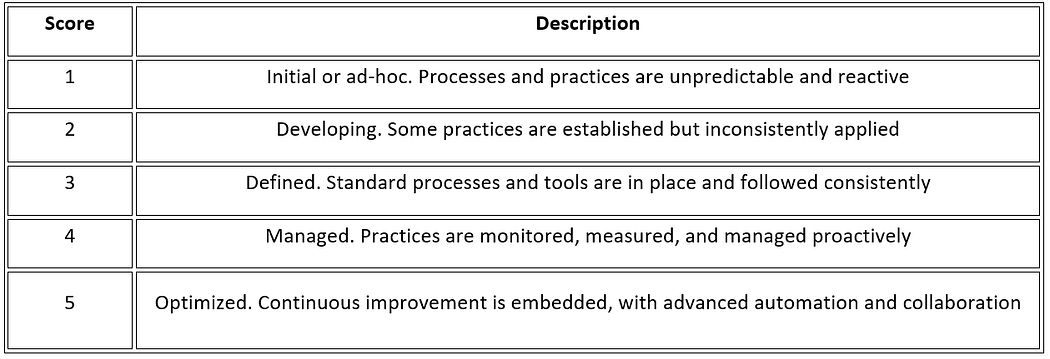
TechNova scored themselves on a 1 to 5 scale following Gartner’s maturity levels
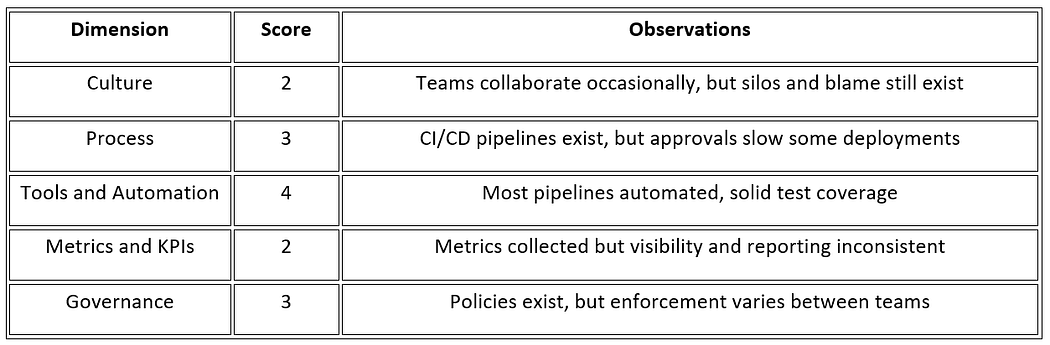
TechNova’s scores
Step 4: Understanding the Results
- Pattern recognition. TechNova has strong automation and processes with scores of 3 and 4, but weaker culture and metrics with scores of 2
- Overall maturity. Average score of approximately 2.8 places the team at a Developing or Defined stage overall
- Insight. The team now has a clear picture of strengths and gaps without making judgments or immediately planning improvements
Step 5: Visualizing the Results
TechNova visualized their scores to communicate effectively
- Radar chart plotting all five dimensions
- Color-coded table with green for strong, yellow for moderate, red for weak
- Summary table showing each dimension’s maturity level
Visuals make it easy to share insights with leadership and help the team understand where they stand today
Key Takeaways
- Choose a framework that fits your goals. Gartner for holistic assessment, CWRF for adoption stages, DORA for delivery metrics
- Ask honest and relevant questions for each dimension
- Score objectively using Gartner’s numeric maturity levels and descriptions
- Analyze patterns across culture, process, tools, metrics, and governance
- Visualize results to communicate gaps clearly and understand your current state
By following this approach, teams can assess their DevOps maturity, identify gaps, and gain clarity on where they stand today without planning or implementing changes
Conclusion
Assessing DevOps maturity is about clarity, not judgment. Using a structured framework like Gartner, asking honest questions, scoring objectively, and interpreting results provides a clear picture of your current state
This insight highlights both strengths and gaps across culture, processes, automation, metrics, and governance without needing to immediately plan improvements
Understanding where you are today is the essential first step toward any meaningful DevOps maturity journey
I hope you found this content informative and enjoyable. For more insightful blogs and updates, consider following and clicking the 👏 button below to show your support. Happy coding! 🚀
Thank you for reading! 💚