In Part 1, we talked about what DevOps maturity is, why it matters, and the five levels that help you understand where your team is today.
Now comes the fun part: actually assessing your maturity. Do not worry, we are not going to drown in spreadsheets or dashboards.
I will walk you through the most useful frameworks, show you simple templates, and give you a practical way to start measuring your team’s progress.
Why Frameworks Matter
Think of a DevOps maturity framework as a lens. It does not magically make your pipelines faster, but it helps you see:
- What is working
- Where the gaps are
- Which improvements will give the most impact
Without a framework, assessments are usually opinion-based: “Yeah, we are pretty mature… I guess?”
With a framework, you have structure and clarity without it feeling like a corporate report.
Organizing the Frameworks
Frameworks can feel overwhelming, so let’s make it simple. I like to think of them in four categories:
1. Formal Models (research-backed, quantitative)
- DORA / Accelerate: Measures deployment frequency, lead time, change failure rate, MTTR.
- Gartner DevOps Maturity: Evaluates culture, processes, tools, metrics, and governance.
- DOI-CAM: Focuses on team capabilities and planning.
2. Informal / Narrative Models (easy to communicate)
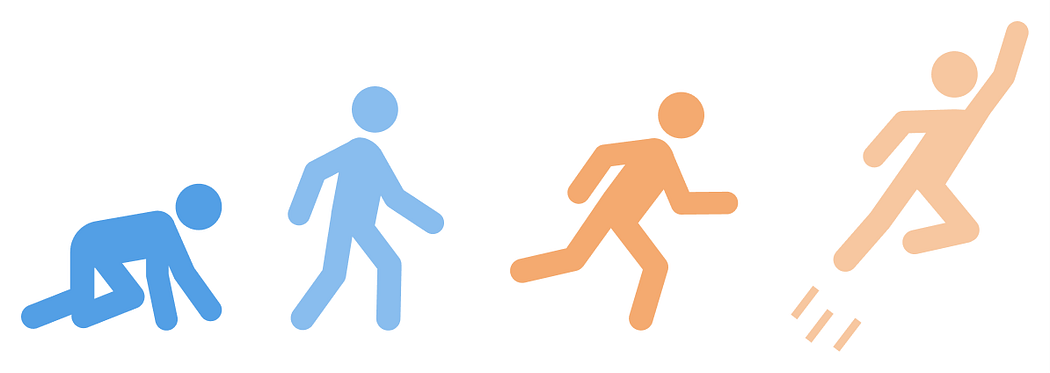
- CWRF (Crawl–Walk–Run–Fly): Shows adoption stages visually, great for executives.
- SAFe Health Radar: Quick team-level maturity check.
- Cloud Vendor Models (AWS, Azure, GCP): Assess cloud-native DevOps practices.
3. Specialized / Emerging Models
- DevSecOps, DataOps, MLOps, GitOps, Platform Engineering: Focus on niche workflows and integrations.
4. Supporting Concepts
- CALMS, ITIL4 DevOps Extension, DOEM: Help guide culture and governance alongside technical practices.
Pro Tip: Pick 2–3 frameworks to start. Trying to use all of them at once will give you analysis paralysis.
Popular Frameworks in Action
Here are the ones I recommend starting with:
1. Crawl–Walk–Run–Fly (CWRF)
CWRF is a high-level, visual framework that shows DevOps adoption across progressive stages. It’s particularly useful for storytelling and executive communication, helping teams see progress without drowning in metrics.
Dimensions / Focus Areas and What to Consider:
1. Culture
- Collaboration and trust across teams
- Openness to feedback and learning from failures
- Willingness to experiment and continuously improve
- Psychological safety to encourage innovation
2. Processes
- Standardized, repeatable workflows
- CI/CD integration and change management
- Incident handling and feedback loops
- Documentation and process visibility
3. Automation
- Build, test, and deployment pipelines automated
- Infrastructure as code and monitoring automation
- Rollbacks and recovery automated
- Minimal manual intervention required
4. Metrics
- Key metrics tracked consistently (deployment frequency, lead time, failure rates)
- Metrics inform decisions and drive improvement
- Real-time visibility into service and pipeline health
- Customer-facing outcomes measured (availability, performance)
5. Collaboration
- Cross-functional teamwork and alignment
- Effective feedback loops between dev, ops, QA, and security
- Knowledge sharing and mentoring
- Efficient communication across distributed teams
Legend / Levels:
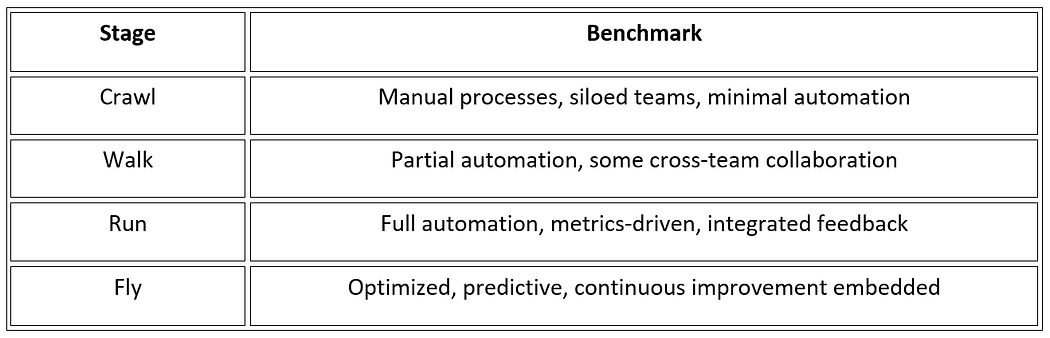
CWRF is great for storytelling — you can show progress to your team or leadership without drowning them in metrics.
2. DORA / Accelerate
DORA is quantitative and focuses on delivery performance. It’s widely used because the metrics are easy to track and actionable.
DORA identified four key indicators of high performing organizations and teams, which are referred to as the four “DORA Metrics”:
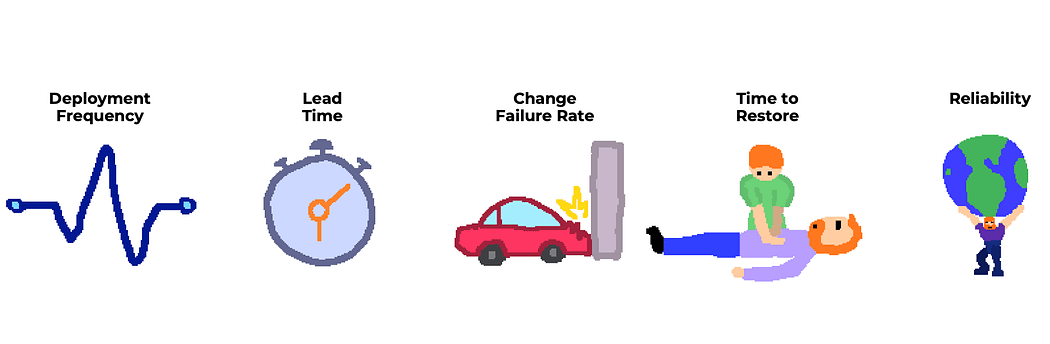
Dimensions / Focus Areas and What to Consider:
1. Deployment Frequency
- How often changes are released to production
- Are small, incremental releases preferred over large, infrequent ones?
- Are releases automated or manual?
2. Lead Time for Changes
- Time from code commit to running in production
- How efficient is the CI/CD pipeline?
- Are there bottlenecks in testing, review, or deployment?
3. Change Failure Rate
- Percentage of deployments causing incidents or degraded service
- How reliable are deployments?
- Are rollback and recovery processes tested and fast?
4. Time to Restore (MTTR)
- Time to recover from failures or outages
- Are monitoring and alerting effective?
- How quickly can teams troubleshoot and fix issues?
5. Reliability (recent addition)
- Service availability and performance
- Correctness: Does the service behave as intended?
- Customer impact: Are failures visible to end users?
Legend / Levels:
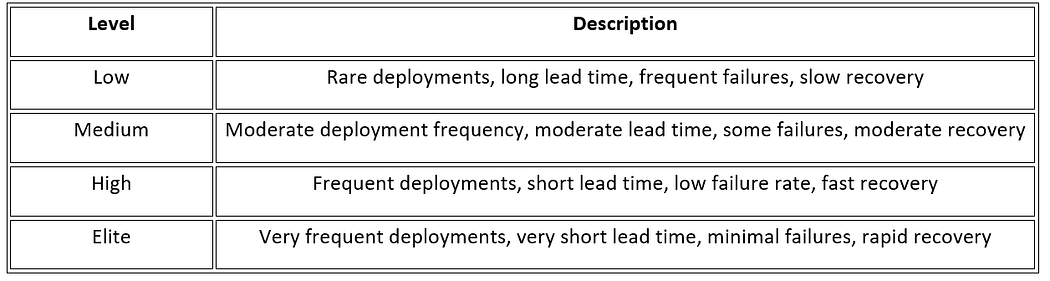
DORA helps you measure tangible improvement, which keeps your team motivated, nothing beats seeing your lead time shrink week over week.
3. Gartner DevOps Maturity / DOI-CAM
Gartner provides a holistic, strategic view of DevOps maturity, evaluating both technical and organizational aspects.
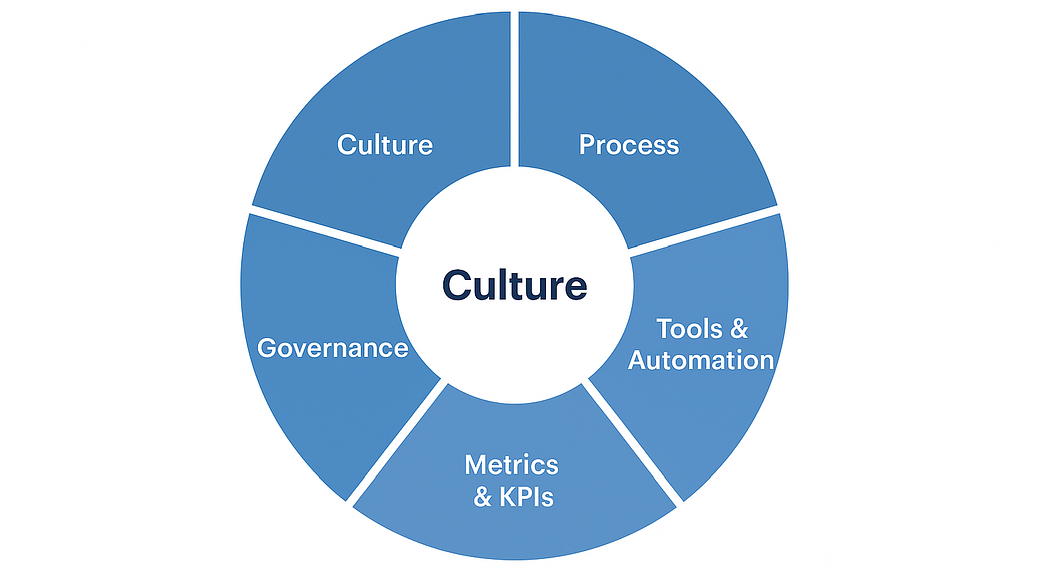
Dimensions / Focus Areas and What to Consider:
1. Culture
- Collaboration, trust, and psychological safety
- Leadership support and alignment
- Learning from failures and sharing knowledge
2. Process
- CI/CD pipeline maturity
- Release management, testing integration
- Incident management and continuous feedback loops
3. Tools & Automation
- Extent and reliability of automation (build, test, deploy)
- Monitoring and infrastructure automation
- Integration of security and compliance tools
4. Metrics & KPIs
- Deployment frequency, lead time, MTTR, and business impact
- Metrics for continuous improvement
- Visibility into system and team performance
5. Governance
- Policies, compliance, accountability
- Risk management and audit readiness
- Alignment of DevOps practices with organizational goals
Legend / Levels:
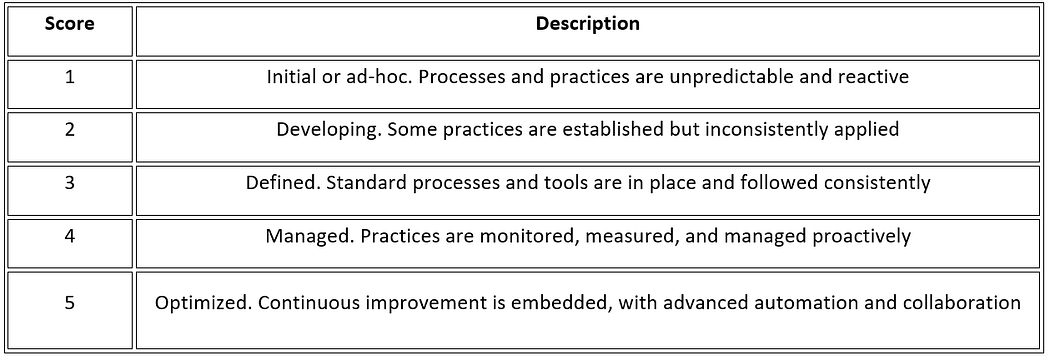
Use Gartner DevOps Maturity for strategic planning, especially if you want to communicate gaps to managers or executives.
How to Start Assessing
Here’s a simple roadmap for your first assessment:
- Pick one framework to start (CWRF or DORA is ideal).
- Do a quick self-assessment, honest answers only.
- Capture the results in a simple table.
- Discuss with your team, gaps are opportunities, not blame.
- Pick one or two high-impact improvements to implement first.
Quick Tip: You don’t need fancy software. Even a Google Sheet or Notion table works perfectly for the first round.
Putting It All Together
The goal isn’t to become an expert in every framework. It is to start seeing where you are and where to go next.
- Use CWRF to tell a story and show progress.
- Use DORA to track measurable delivery performance.
- Use Gartner/DOI-CAM to identify broader gaps in culture, governance, and process.
Together, they give you a holistic view without overwhelming you.
Conclusion
Assessing DevOps maturity doesn’t have to be complicated. Start small, pick the frameworks that resonate, and focus on honest reflection. Metrics and tables are useful, but the real power comes from the conversations and improvements that follow.
In Part 3, we’ll take this one step further: a real-world example and roadmap showing how a team can move from Crawl to Fly with practical steps you can adapt to your own context.
I hope you found this content informative and enjoyable. For more insightful blogs and updates, consider following and clicking the 👏 button below to show your support. Happy coding! 🚀
Thank you for reading! 💚